



What is a Gigli saw?
A Gigli saw is a flexible, twisted stainless steel wire saw used in surgery to cut bone. Each wire has a loop at both ends. Two T-handles hook into the loops, the wire is passed around the bone, and the surgeon pulls it back and forth to cut. It is also known as a Gigli wire saw, wire saw, string saw, thread saw or cable saw.
This set contains everything needed to start: three Gigli wires in the standard lengths of 30 cm (12″), 50 cm (20″) and 70 cm (28″), and two T-handles, all in medical-grade stainless steel, reusable and autoclavable.
Request bulk priceWhatsApp sales
What’s in the set
| Item | Details |
|---|---|
| Gigli wires | 3 wires: 30 cm (12″), 50 cm (20″), 70 cm (28″), twisted stainless steel with end loops |
| Handles | 2 T-handles with hooks that lock into the wire loops |
| Material | Medical-grade stainless steel |
| Reprocessing | Reusable and autoclavable |
| Specialties | Orthopaedics, neurosurgery, trauma and amputation surgery |
The Gigli saw range
- Gigli saw wires: replacement wires in 30, 50 and 70 cm, single, double or triple twisted.
- Gigli saw handles: T-handles sold separately, in pairs.
- Single-use sterile Gigli wire: individually packed, sterile, for one patient only.
Parts of a Gigli saw
- Cutting wire: several stainless steel strands twisted together; the twists form the cutting surface.
- End loops: a closed loop at each end of the wire.
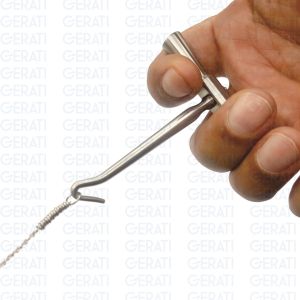
- Handles: T-shaped handles with a hook that holds each loop, giving grip and control.
- Wire guide (passer): often used to pass the wire safely around the bone.
Sizes and wire types
| Length | Typical use |
|---|---|
| 30 cm (12″) | Smaller bones and tight spaces, such as cranial work |
| 50 cm (20″) | General orthopaedic and amputation use |
| 70 cm (28″) | Large bones and deep access, such as the femur and pelvis |
Wires come as single, double or triple twisted strands. Twisted wires are stronger and give a smoother, more reliable cut. Read the Gigli saw buying guide to choose the right one.
What is a Gigli saw used for?
Gigli saws are used where bone must be cut from the deep side outwards or in a confined space: amputations, craniotomy, symphysiotomy, pelvic osteotomies and bone resections, as well as field, trauma and veterinary surgery. See all Gigli saw uses.
How does a Gigli saw work?
The wire is passed around the bone, both loops are hooked onto handles, and the surgeon pulls the handles in alternating strokes while keeping the wire in a wide V. The twisted strands cut by friction. Learn more in how a Gigli saw works, or compare it with powered saws in Gigli saw vs other bone saws.
Care and sterilisation
After use, clean the wire and handles, inspect the wire for kinks, frays or worn strands, then autoclave with your hospital’s validated steam cycle. Replace any damaged wire. For guaranteed sharpness every time, use single-use sterile Gigli wires.
History of the Gigli saw
The wire saw is named after the Italian obstetrician Leonardo Gigli (1863–1908), who introduced it in the 1890s for cutting the pubic bone in difficult births. Surgeons soon adopted it for amputations and for cutting the skull between burr holes, and it remains in use today.
Bulk supply and private label
GERATI supplies Gigli saw sets, wires, handles and single-use sterile wires to distributors, hospitals and procurement agencies. Bulk prices on request, with private-label marking and packing available.
Request bulk priceWhatsApp sales
Gigli saw FAQ
What is a Gigli saw?
A Gigli saw is a flexible wire saw used in surgery to cut bone. It is a twisted stainless steel wire with a loop at each end; handles hook into the loops and the surgeon pulls the wire back and forth around the bone.
What is a Gigli saw used for?
Mainly for amputations, craniotomy, symphysiotomy and pelvic osteotomies, and wherever bone must be cut from the deep side outwards or in a tight space. See the full list of Gigli saw uses.
How does a Gigli saw work?
The twisted strands form a rough cutting surface. The wire is passed around the bone, both loops are attached to handles, and alternating pulls with the wire held in a wide V cut through the bone by friction.
What sizes do Gigli saw wires come in?
The most common lengths are 30 cm (12 inches), 50 cm (20 inches) and 70 cm (28 inches). Wires come as single, double or triple twisted strands.
Are Gigli saws reusable or single-use?
Both exist. GERATI makes reusable, autoclavable stainless steel Gigli wires and handles, and single-use sterile Gigli wires for one patient only.
How is a reusable Gigli saw sterilised?
Clean and inspect the wire after use, then autoclave it with the handles using your hospital’s validated steam cycle. Replace any wire that is kinked, frayed or blunt.
What other names is the Gigli saw known by?
It is also called a Gigli wire saw, wire saw, string saw, thread saw, cable saw or bone-cutting wire, and is often misspelled as giggly, jiggly, gigly or gili saw.
Who invented the Gigli saw?
The Italian obstetrician Leonardo Gigli (1863–1908) introduced the wire saw in the 1890s for cutting the pubic bone during difficult childbirth. It was soon adopted in orthopaedics and neurosurgery.
How do I buy Gigli saws in bulk?
Send your quantities to sales@gerati.com or on WhatsApp. Bulk prices are given on request for sets, wires, handles and single-use sterile wires, including private-label packing.


marcello.gomez –
Hi Aqeel.
Your shipment of Gigli wire saw has just arrived and we have checked it. Everything is fine. Our quality inspectors have checked the quality and they seem to be satisfied, We will order again very soon. Thanks for your efforts!