

Macintosh laryngoscope
The Macintosh is a curved laryngoscope blade, introduced by Sir Robert Macintosh in 1943 and today the most widely used blade for adult intubation. GERATI makes it in eight versions: four standard and four flexible tip, conventional and fiber optic, in sizes 00 to 5.
- 42 blade references
- Sizes 00 to 5
- AISI 304 stainless steel
- ISO 7376 hook-on fitting
Parts of a Macintosh blade

- 1Tip. Rounded, sits in the vallecula.
- 2Light outlet. Where light leaves the fiber guide.
- 3Spatula. The curved surface that lifts the tongue.
- 4Flange. Side wall that moves the tongue aside.
- 5Laser marking. Brand, size, code and CE mark.
- 6Hook-on heel. ISO 7376 fitting with a spring-ball lock.
Macintosh versions
All versions share the same curved profile and fitting. They differ in where the lamp sits and how light reaches the tip. Conventional blades fit conventional handles; the three fiber optic versions fit green-system handles.
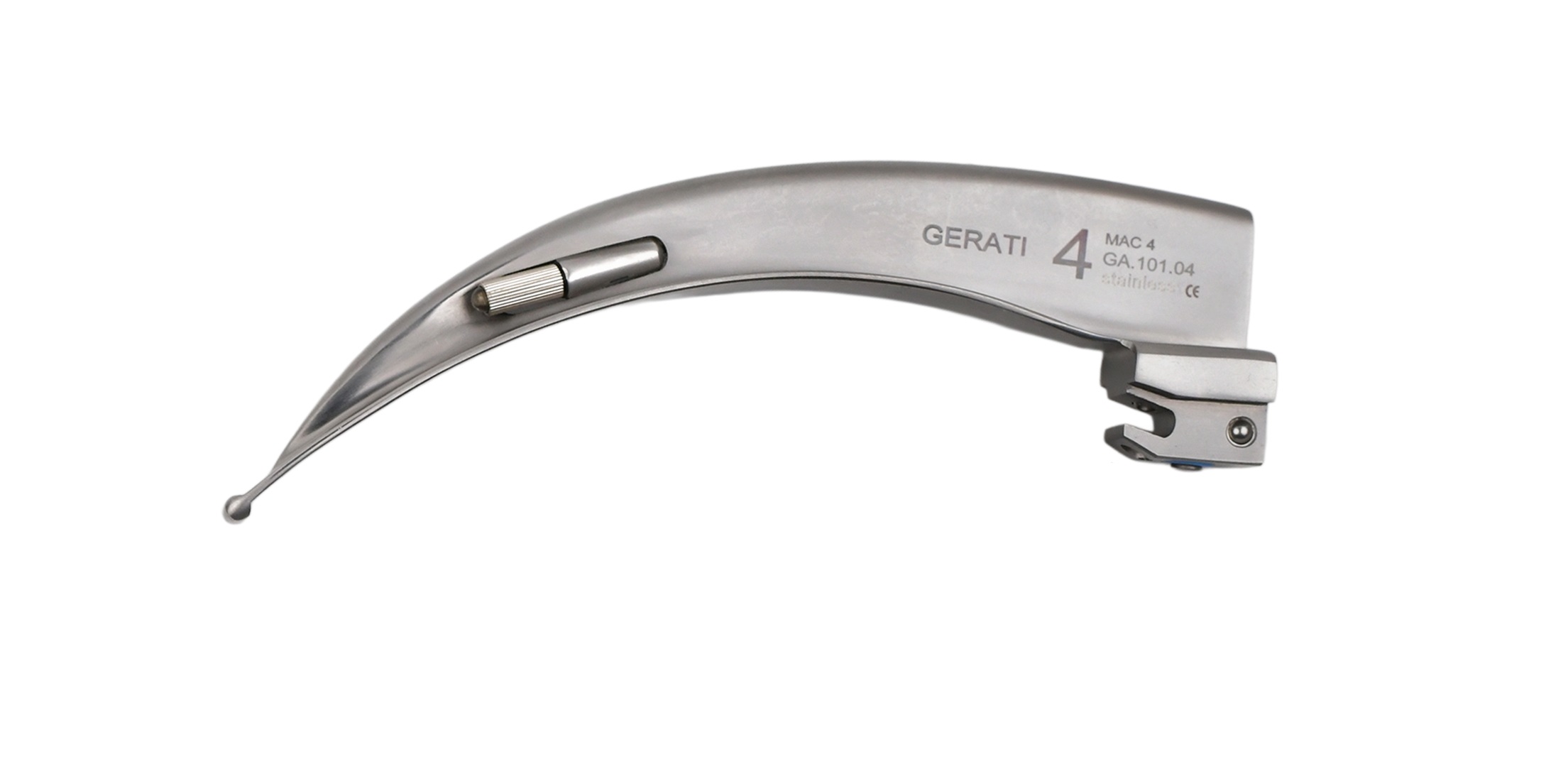
GA 101
Conventional
A 2.5 V LED lamp sits on the blade and takes power through the handle contact. Lowest cost. Remove the lamp before reprocessing.
- Sizes
- 00 to 5
- Handles
- GB 200, 202, 203
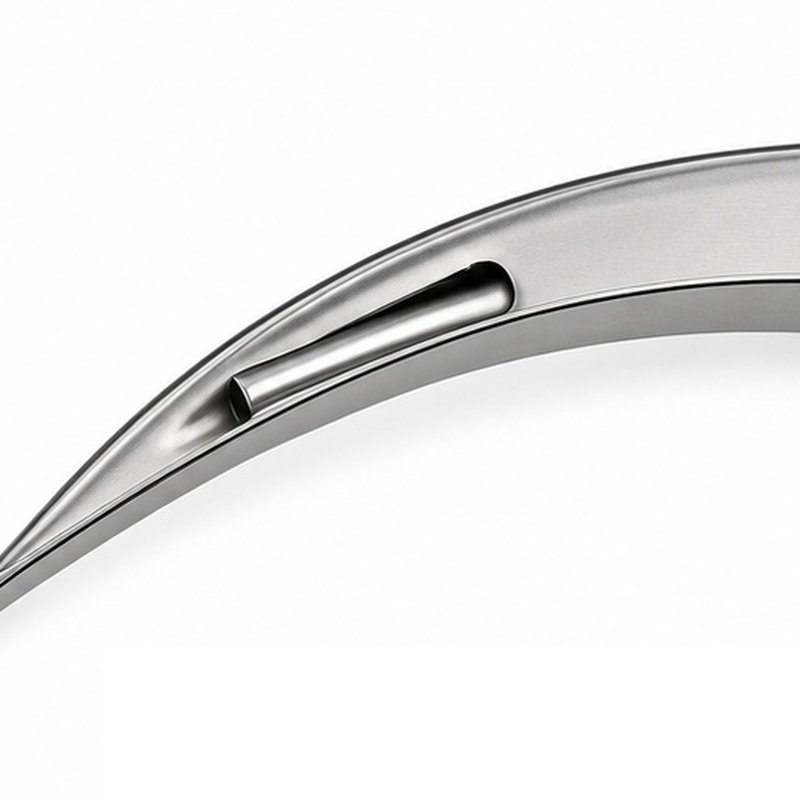
GA 102
Fiber optic, interchangeable
The lamp is in the handle. A fiber light guide carries light to the tip and can be removed from the blade for cleaning or replacement.
- Sizes
- 00 to 5
- Handles
- GB 300, 302, 303
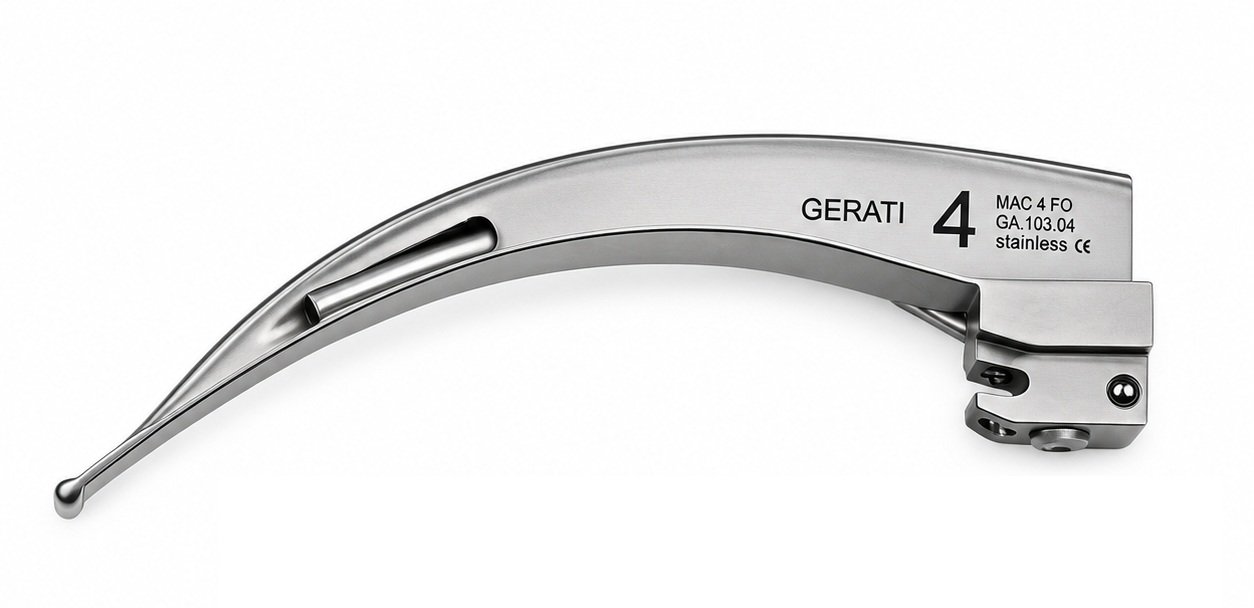
GA 103
Fiber optic, fixed tube
The fiber guide is laser welded to the blade. No gaps where soil can collect, fewer parts, simpler reprocessing.
- Sizes
- 00 to 5
- Handles
- GB 300, 302, 303
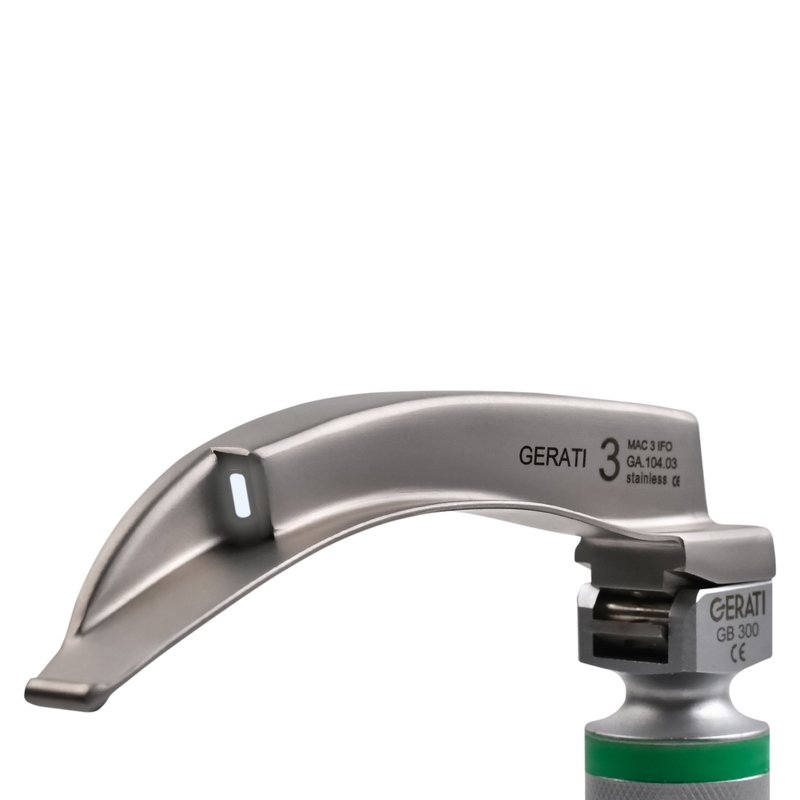
GA 104
Fiber optic, integrated
The fiber channel is built into the blade body, giving a smooth, low-profile surface with no tube on the spatula.
- Sizes
- 1 to 5
- Handles
- GB 300, 302, 303
Macintosh flexible tip (GA 301–304)
A McCoy-type Macintosh blade with a lever on the back. Pressing the lever raises the hinged tip for extra lift of the epiglottis, without more force on the handle. Available in conventional and three fiber optic versions, sizes 1 to 4. See flexible tip blades
Codes and working lengths
Every standard Macintosh code with its working length is in the size table below. Compare light systems in detail: fiber optic vs standard blades.
Macintosh blade sizes and product codes
Seven sizes cover patients from premature infants to very large adults. Each cell shows the product code and working length; size 00 codes end in -20, size 0 in -00. A dash means that size is not made in that version.
| Size | Typical patient group | GA 101 Conventional | GA 102 Fiber optic, interchangeable | GA 103 Fiber optic, fixed tube | GA 104 Fiber optic, integrated |
|---|---|---|---|---|---|
| Mac 00 | Premature infants | GA 101-20 · 45 mm | GA 102-20 · 45 mm | GA 103-20 · 45 mm | – |
| Mac 0 | Neonates | GA 101-00 · 58 mm | GA 102-00 · 58 mm | GA 103-00 · 58 mm | – |
| Mac 1 | Infants | GA 101-01 · 70 mm | GA 102-01 · 80 mm | GA 103-01 · 70 mm | GA 104-01 · 70 mm |
| Mac 2 | Children | GA 101-02 · 88 mm | GA 102-02 · 92 mm | GA 103-02 · 88 mm | GA 104-02 · 90 mm |
| Mac 3 | Most adults | GA 101-03 · 112 mm | GA 102-03 · 116 mm | GA 103-03 · 112 mm | GA 104-03 · 112 mm |
| Mac 4 | Large adults | GA 101-04 · 134 mm | GA 102-04 · 135 mm | GA 103-04 · 134 mm | GA 104-04 · 135 mm |
| Mac 5 | Very large adults | GA 101-05 · 175 mm | GA 102-05 · 175 mm | GA 103-05 · 175 mm | GA 104-05 · 145 mm |
Flexible tip blades (GA 301–304) come in sizes 1 to 4; see the flexible tip page for their codes.
Patient groups are general guidance only. Blade selection is always a clinical decision.
How the Macintosh blade works
The blade is inserted on the right side of the mouth and the flange moves the tongue to the left. The rounded tip is advanced into the vallecula, the space between the base of the tongue and the epiglottis. Lifting the handle forward and upward raises the epiglottis indirectly and brings the vocal cords into view.
Because the tip does not touch the epiglottis itself, the curved blade is widely used for routine adult intubation. Read more about Macintosh blade uses.
Macintosh or Miller?
- Macintosh: curved, lifts the epiglottis indirectly; the usual choice for adults
- Miller: straight, lifts the epiglottis directly; often preferred for neonates, infants and young children
- Both fit the same handle, as long as the light system matches
- Many hospitals stock both, which is why our anesthesia kits (GA 120-50 and GA 120-52) include both patterns
Macintosh laryngoscope sets
Each set contains one battery handle, the blades listed, 2 spare LED lamps and a hard case. The set code combines the family and the suffix: for example, GA 102-44 is a fiber optic interchangeable set with blades 1 to 4.
| Blade sizes | Handle | Conventional | Fiber optic, interchangeable | Fiber optic, fixed tube | Fiber optic, integrated |
|---|---|---|---|---|---|
| 2, 3, 4 | Adult | GA 101-30 | GA 102-30 | GA 103-30 | – |
| 0, 1, 2, 3 | Adult | GA 101-40 | GA 102-40 | GA 103-40 | – |
| 1, 2, 3, 4 | Adult | GA 101-44 | GA 102-44 | GA 103-44 | GA 104-44 |
| 1, 2, 3, 4, 5 | Adult | GA 101-52 | GA 102-52 | GA 103-52 | GA 104-45 |
| 00, 0, 1, 2, 3 | Paediatric | GA 101-50 | GA 102-50 | GA 103-50 | – |
Flexible tip sets GA 301-30 to GA 304-30 contain blades 2, 3 and 4. See all laryngoscope sets
Specifications
- AISI 304 stainless steel, satin anti-glare finish
- 2.5 V LED light: on the blade (conventional) or in the handle (fiber optic)
- Hook-on fitting to ISO 7376 dimensions
- Steam autoclave up to 134 °C or high-level disinfection
- 5-year warranty against material and manufacturing defects
- CE marked, Class I, made under an ISO 13485 quality system
Match the blade to the handle: conventional blades with conventional handles, fiber optic blades with green-system handles.
Macintosh blades under your brand
The laser marking shown above can carry your logo, reference and lot number instead of ours, with your choice of finish, case and packaging. Private label starts at 50 units per model.
See the OEM programmeLearn more
- Complete guide to laryngoscope bladesAll blade types compared
- Macintosh laryngoscope bladesUses, sizes and technique
- Fiber optic vs standard bladesWhich light system to choose
Frequently asked questions
Who invented the Macintosh laryngoscope?
Sir Robert Macintosh, an anaesthetist at Oxford, introduced the curved blade in 1943. It remains the most widely used laryngoscope blade.
What are the parts of a Macintosh blade?
The rounded tip, the curved spatula that lifts the tongue, the flange (side wall) that moves the tongue aside, the light source or light outlet near the tip, and the heel with the hook-on fitting that locks onto the handle.
What size Macintosh blade is used for adults?
Mac 3 is the most common adult size, and Mac 4 is used for larger adults. Blade selection is always a clinical decision.
What is the difference between the four GERATI light systems?
Conventional blades (GA 101) carry an LED lamp on the blade. Fiber optic blades take light from a lamp in the handle: GA 102 has a removable light guide, GA 103 a laser-welded tube and GA 104 a channel built into the blade.
What is the difference between Macintosh and McCoy blades?
A McCoy blade is a Macintosh blade with a hinged tip that is raised by a lever on the handle side. GERATI makes it as the Macintosh flexible tip range, GA 301 to 304.
Will GERATI Macintosh blades fit my existing handles?
Yes, if the handles use the standard hook-on fitting and the same light system: conventional with conventional, fiber optic with green-system fiber optic. We recommend testing a sample first.
Can Macintosh blades be autoclaved?
Yes, up to 134 °C: pre-vacuum 132–134 °C for 4 minutes, or gravity 121 °C for 30 minutes, after cleaning with an enzymatic cleaner. On conventional blades, remove the lamp first. Follow the instructions for use.
Order Macintosh blades or sets
Tell us the versions, sizes and quantities you need. We reply with prices, lead times and the documents available for your market.
Email sales@gerati.com WhatsApp +92 300 8610614- 8 Macintosh versions, sizes 00 to 5
- Conventional and fiber optic
- Sets with 2 spare LED lamps and hard case
- ISO 13485 quality system, CE marked, Class I
- OEM and private label from 50 units per model