

Laryngoscope blades at a glance
- The blade is the part of the laryngoscope that lifts the tongue and epiglottis and lights the airway for intubation.
- Three main patterns: Macintosh (curved), Miller (straight) and McCoy (curved, with a hinged flexible tip).
- Sizes run from 00 (extremely preterm newborns) to 5 (very large adults). For most adults the blade is a Macintosh 3; a Macintosh 4 is the usual alternative for larger or taller adults.
- Two light systems: conventional (lamp on the blade) and fiber optic (lamp in the handle). They need matching handles.
- Reusable blades are stainless steel and can be steam sterilized; single-use blades are usually plastic or metal.
Introduction
GERATI Healthcare designs and makes reusable laryngoscope blades and handles in Sialkot, Pakistan, for distributors, hospitals and OEM brands.
Laryngoscope blades are critical tools in airway management, helping clinicians visualize the larynx during intubation. The right blade choice can make a procedure safer, faster and more comfortable for the patient. See our range of laryngoscopes.
In this complete guide, we explain everything you need to know about laryngoscope blades: their types, parts, sizes, materials and light sources, how blades match handles, and how they are chosen, cleaned and maintained. Each section links to a more detailed article or product page.
1. What Are Laryngoscope Blades?
A laryngoscope blade is the part of a laryngoscope inserted into a patient’s mouth to move the tongue and epiglottis, allowing direct visualization of the vocal cords. A laryngoscope has two parts: a battery handle, which holds the power source, and a detachable blade. Blades come in multiple designs, lengths and curvatures to suit different patients.
Key functions:
- Lift the tongue and epiglottis to expose the airway
- Guide the placement of an endotracheal tube
- Provide illumination, from a lamp on the blade or a fiber optic light guide
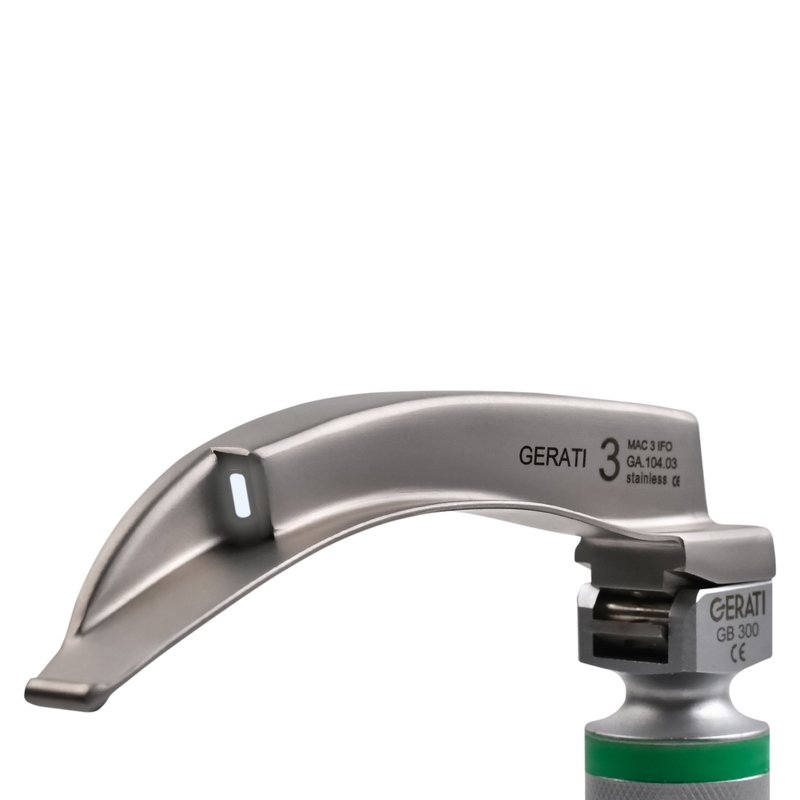
Parts of a laryngoscope blade
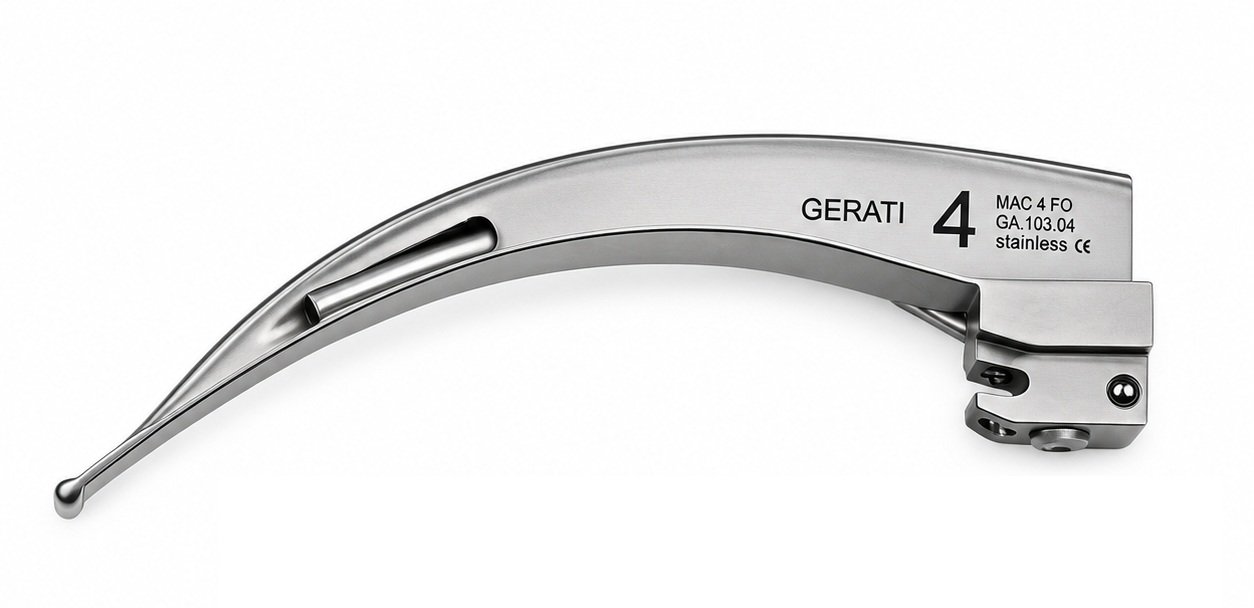
- 1Tip: placed in the vallecula (curved) or under the epiglottis (straight)
- 2Light outlet: where the light leaves the lamp or fiber guide
- 3Spatula: the long surface that lifts the tongue
- 4Flange: side wall that keeps the tongue out of view
- 5Marking: brand, size, product code and CE mark
- 6Heel: hook-on fitting that locks onto the handle
2. Main Types of Laryngoscope Blades
Different designs have evolved to meet specific clinical needs. The two most common types are the curved Macintosh and the straight Miller. A third, the McCoy, adds a movable tip to the Macintosh shape.
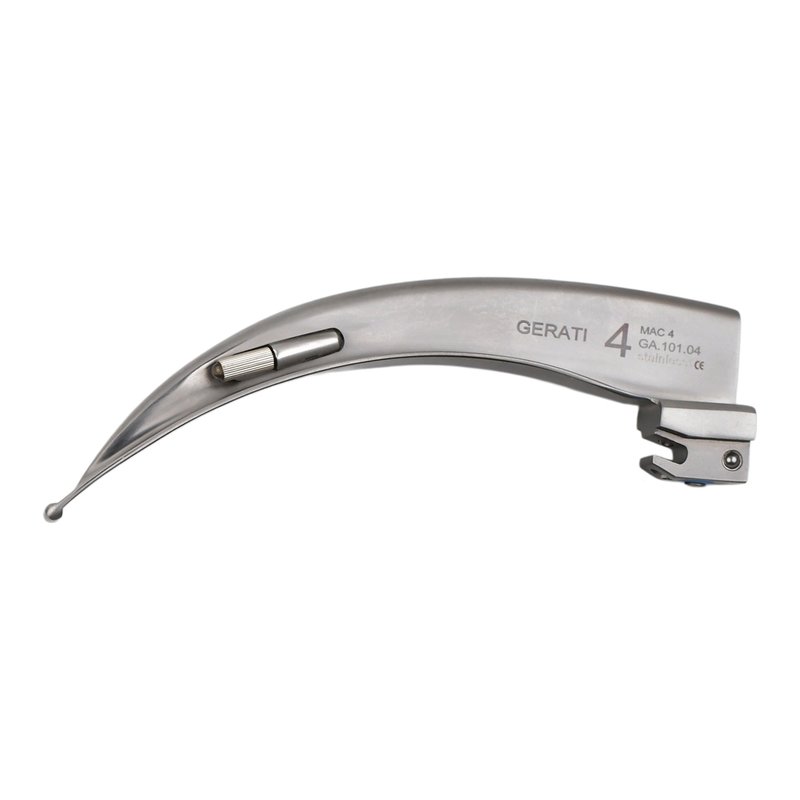
Macintosh Blades (Curved)
- Curved tip fits into the vallecula, the space between the base of the tongue and the epiglottis
- Lifts the epiglottis indirectly
- The most widely used blade for adults; sizes 00 to 5
Read more: Macintosh laryngoscope blades: features, uses and benefits · GERATI Macintosh blades, sizes and codes
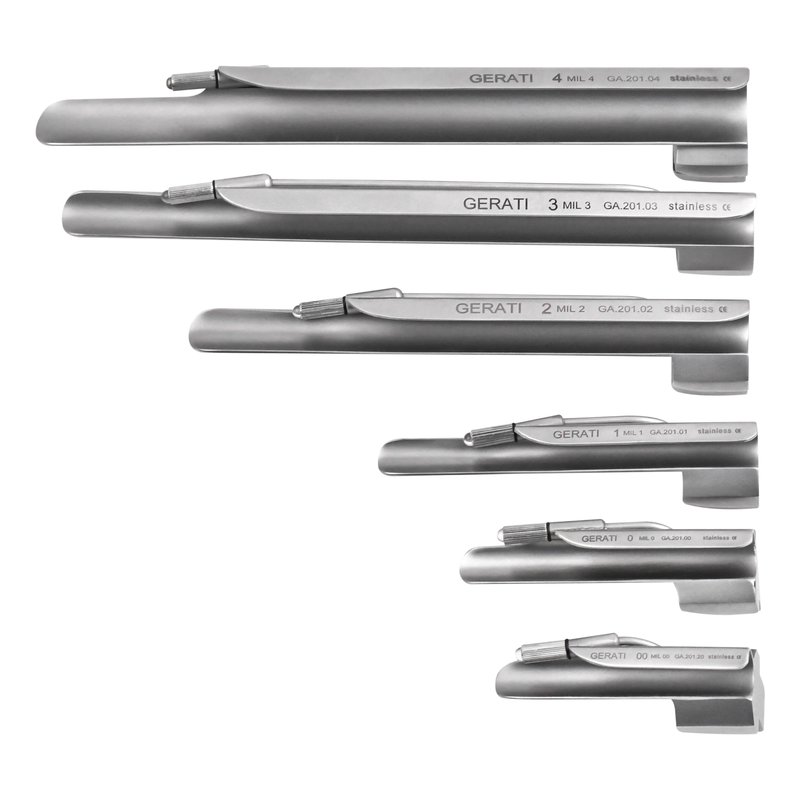
Miller Blades (Straight)
- Straight blade with a slight curve at the tip, lifts the epiglottis directly
- Often preferred for neonates, infants and young children, and in some adult cases when a curved blade gives a limited view
- Sizes 00 to 4
Read more: Miller laryngoscope blades: features, uses and benefits · GERATI Miller blades, sizes and codes
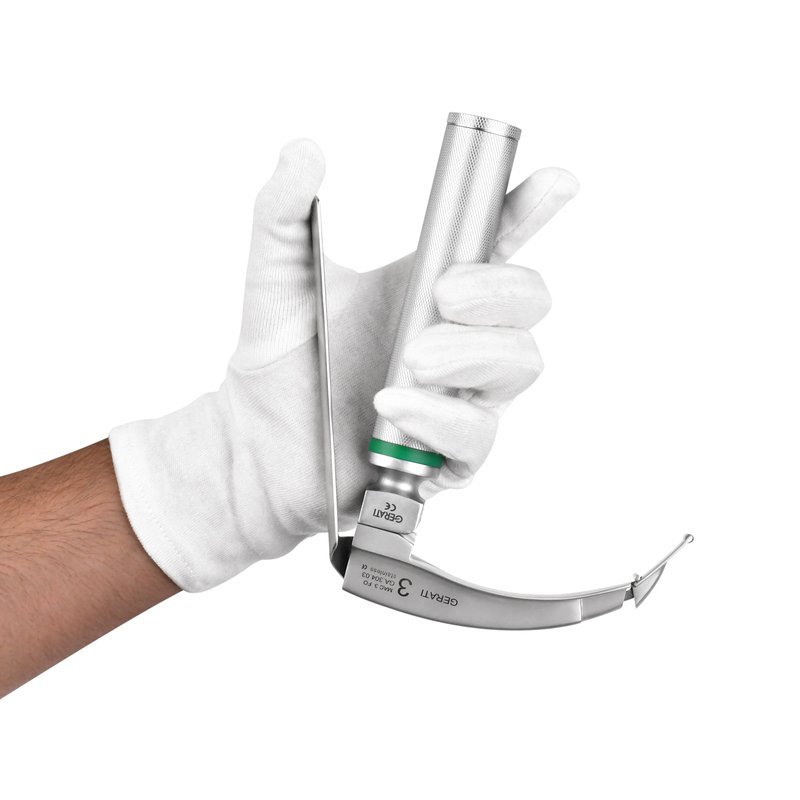
McCoy (Flexible Tip) Blades
A McCoy blade is a Macintosh blade with a hinged tip. Pressing a lever on the back of the blade raises the tip, giving extra lift of the epiglottis without more force on the handle. Clinicians often keep one for cases where a standard Macintosh gives a limited view.
Read more: McCoy flexible tip blades
Other blade designs
Other straight blades, such as the Wisconsin and Phillips patterns, are used in some hospitals. Video laryngoscopes are a separate class of device: a camera near the blade tip shows the airway on a screen, so the clinician does not need a direct line of sight.
3. Blade Materials
Laryngoscope blades and handles are made from different materials, each with pros and cons:
- Stainless steel: durable, corrosion-resistant and suitable for repeated steam sterilization. GERATI blades are AISI 304 stainless steel.
- Plastic (single-use): used for disposable blades to remove the need for reprocessing.
- Chrome-plated brass: used mainly for handle bodies; GERATI handles combine a chrome-plated brass body with a stainless steel connector.
Finish matters too: a satin, anti-glare finish reduces reflection from operating lights.
Read more: Laryngoscope blade materials and durability
4. Light Source Options
Modern blades differ in where the lamp sits and how light reaches the tip.
Standard (Conventional)
- A small lamp sits on the blade near the tip and is powered through the contact with the handle
- Older blades used halogen or xenon bulbs; LED lamps are now standard
- The lamp can be replaced, and must be removed before reprocessing
Fiber Optic
- The lamp sits in the handle, and a fiber light guide carries the light to the blade tip
- No lamp or electrical contacts on the blade, which simplifies reprocessing
- Fiber optic handles carry a green ring, the mark of the “green system”
- Three versions: interchangeable (removable light guide), fixed tube (guide welded to the blade) and integrated (channel built into the blade)
Which handle fits which blade
Blades and handles connect with a hook-on fitting whose dimensions are set by the international standard ISO 7376. The fitting is shared, but the light system must match:
| Blade type | Handle needed | GERATI handles |
|---|---|---|
| Conventional (lamp on blade) | Conventional handle with a contact at the top | GB 200, 202, 203 |
| Fiber optic (light guide in blade) | Fiber optic handle with the lamp inside, green ring | GB 300, 302, 303 |
Adult handles take 2 C batteries; paediatric and stubby handles take 2 AA batteries.
Read more: Fiber optic vs standard laryngoscope blades · Why LED fiber optic blades suit bulk hospital purchases · GERATI battery handles
5. Disposable vs Reusable Blades
- Disposable: no reprocessing needed and a fresh blade for every patient, but a higher cost per use and more waste
- Reusable: lower cost over the life of the blade, but each use needs cleaning and sterilization or high-level disinfection that meets hospital protocols
The right choice depends on patient volume, reprocessing capacity, infection control policy and budget. GERATI’s catalogue range is reusable; single-use items for tenders can be discussed on request.
Read more: Disposable vs reusable laryngoscope blades
6. Pediatric & Specialty Blades
Certain blade designs and sizes are made specifically for neonates and infants. Pediatric blades are shorter and narrower, so they fit a small mouth and airway. Straight Miller blades are often preferred in this age group because they lift the relatively large, floppy epiglottis of an infant directly. Neonatal resuscitation guidance commonly suggests a Miller 1 for term newborns, a Miller 0 for preterm newborns and a Miller 00 for extremely preterm babies.
Smaller blades are used with slimmer paediatric handles, which are lighter and easier to control. Specialty blades include the McCoy flexible tip described in section 2.
Read more: Miller blades for neonates and children · Paediatric laryngoscope sets · McCoy flexible tip blades
7. Choosing the Right Blade
Factors to consider:
- Patient age and anatomy: decides the pattern and size
- Procedure type: routine, emergency or anticipated difficult airway
- Lighting needs: conventional or fiber optic, and the handles already in use
- Infection control policies: reusable or single-use, and how blades are reprocessed
- Budget and usage frequency: cost per use over the life of the blade
Laryngoscope blade size for adults
Short answer
Most adults are intubated with a Macintosh 3 blade. A Macintosh 4 is the usual alternative for larger or taller adults, or when the tip of a size 3 does not reach the vallecula. With straight blades, a Miller 3 suits most adults and a Miller 4 large adults. Many clinicians keep both sizes ready, because the right blade depends on the individual airway.
Is a bigger blade better? Some clinicians prefer a size 4 for every adult, reasoning that the extra length helps reach a deep vallecula. Two large studies of critically ill adults point the other way. A multicentre study in French intensive care units (Godet and colleagues, 2022) and a US analysis of six trials (Landefeld and colleagues, 2023) both found that intubation succeeded on the first attempt more often with a size 3 than a size 4. The US study also found a better view of the vocal cords with size 3.
US study of 584 critically ill adults intubated with a Macintosh blade in emergency departments and ICUs (Landefeld et al., Critical Care Explorations, 2023). An observational analysis: it shows an association, not proof that size 3 is always right.
The authors suggest a longer blade is harder to control and is often pushed in too far. When Sir Robert Macintosh introduced his blade, only one adult size existed, close to today’s size 3; the size 4 was added later for larger patients.
What points to a different size in an adult:
- Height and neck length: tall patients and long necks may need the extra reach of a size 4.
- Short thyromental distance (a short distance from chin to the top of the larynx): smaller blades have been linked to fewer failed intubations in these patients.
- Missing teeth: in edentulous adults, a smaller blade gave a better view in one study.
- Limited mouth opening or neck movement: a McCoy flexible tip blade or a video laryngoscope may be planned as a backup.
In GERATI’s range, a Macintosh 4 is 22 mm longer than a Macintosh 3 (134 mm against 112 mm in the conventional version), which is the extra reach, and the extra length to control.
Laryngoscope blade size chart
Blade sizes are numbered from 00 to 5. Smaller numbers are shorter blades for smaller patients. The table gives typical uses and the working lengths of GERATI conventional blades.
| Size | Macintosh: typical use | Miller: typical use | Macintosh length | Miller length |
|---|---|---|---|---|
| 00 | Rarely used | Extremely preterm newborns | 45 mm | 45 mm |
| 0 | Neonates (curved blades are less common) | Preterm newborns | 58 mm | 55 mm |
| 1 | Infants | Term newborns and infants | 70 mm | 80 mm |
| 2 | Children | Children | 88 mm | 130 mm |
| 3 | Most adults | Adults | 112 mm | 170 mm |
| 4 | Larger or taller adults | Large adults | 134 mm | 180 mm |
| 5 | Very large adults (rarely needed) | Not made | 175 mm | – |
Macintosh Miller (working length, same scale)
Typical uses are general guidance only. Blade size depends on the individual patient and is always a clinical decision.
Same size number, different length
A blade’s size number is a designation, not a measurement. A “size 3” from one maker can differ from another’s in length, flange height and curve. The two classic Macintosh styles differ too: the American style has a higher flange and a less continuous curve than the English original. Lengths can even differ within one maker’s range:
| GERATI blade | Conventional | Fiber optic, interchangeable | Fiber optic, integrated |
|---|---|---|---|
| Macintosh 1 | 70 mm | 80 mm | 70 mm |
| Macintosh 3 | 112 mm | 116 mm | 112 mm |
| Macintosh 5 | 175 mm | 175 mm | 145 mm |
When a hospital mixes brands, or replaces blades from a new supplier, compare the working length of the actual blade, not just the number printed on it.
Which sizes should a department stock?
| Department | Typical blade range | Matching GERATI sets |
|---|---|---|
| Neonatal unit | Miller 00, 0 and 1 | -50 sets: blades 00 to 3 with a paediatric handle |
| Paediatric ward and theatre | Miller 1 and 2; Macintosh 1 to 3 | -40 sets (blades 0 to 3) or -50 sets |
| Adult operating theatre | Macintosh 3 and 4, plus a straight blade | -30 sets (Macintosh 2 to 4) or -44 sets (1 to 4) |
| Emergency department, ICU, ambulance | Macintosh 3 and 4, a McCoy, size 5 for very large adults; video laryngoscope as backup where available | -52 sets (Macintosh 1 to 5) and McCoy -30 sets |
| Training centre | Full Macintosh and Miller range | Anesthesia kits GA 120-50 and GA 120-52 |
Read more: All blade sizes and product codes · Macintosh sizes · Miller sizes
8. Maintenance & Sterilization
To ensure long life and patient safety, follow the instructions for use and your hospital’s reprocessing protocol. Infection control guidance generally treats laryngoscope blades as semi-critical devices, which need at least high-level disinfection between patients; many hospitals steam sterilize reusable blades. A typical cycle for a reusable blade:
- Wipe the blade at the point of use and keep it moist until cleaning.
- Remove the lamp from conventional blades, and the light guide from interchangeable fiber optic blades.
- Clean with an enzymatic detergent and a soft brush, then rinse and dry.
- Inspect: check for damage, corrosion, a loose fitting and a working light.
- Steam sterilize (pre-vacuum 132–134 °C for 4 minutes, or gravity 121 °C for 30 minutes) or use high-level disinfection.
- Store dry and protected, and check the light before each use.
Handles are cleaned and disinfected separately, with the batteries removed, as described in their instructions for use.
Read more: How GERATI blades are made and checked · Spare lamps and light guides
9. History & Innovations
The laryngoscope has evolved since its invention in the 19th century:
1895: Alfred Kirstein in Berlin performs the first direct view of the larynx with a handheld instrument.
1941: Robert Miller describes the straight Miller blade.
1943: Sir Robert Macintosh, an anaesthetist at Oxford, publishes the curved Macintosh blade, developed with his technician Richard Salt. At first there were only an adult and a child size; the adult size is close to today’s Macintosh 3.
Early 1950s: the hook-on fitting becomes the standard way to attach a blade, letting it fold against the handle when not in use. Its dimensions are now set by ISO 7376.
1993: McCoy and Mirakhur describe the levering, flexible tip blade.
Today: LED lighting, fiber optic light guides, laser-welded and integrated fiber channels, and blades designed to withstand repeated steam sterilization.
10. GERATI Healthcare’s Advantage
What GERATI offers distributors, hospitals and OEM brands:
- 60 reusable blades: Macintosh, Miller and McCoy patterns, sizes 00 to 5, in conventional and three fiber optic versions
- AISI 304 stainless steel, satin anti-glare finish, autoclavable up to 134 °C
- ISO 7376 hook-on fitting; fiber optic models designed for green-system compatibility
- ISO 13485 quality system; CE marked as Class I under the EU MDR
- 5-year warranty on blades and handles
- OEM and private label from 50 units per model, with your laser marking, finish and packaging
Blades are also supplied in laryngoscope sets with a handle, 2 spare LED lamps and a hard case, in standard and fiber optic versions. See the full blade range or the OEM programme.

Frequently asked questions
What size laryngoscope blade is used for adults?
Macintosh 3 for most adults. Macintosh 4 is the usual alternative for larger or taller adults, or when a size 3 does not reach the vallecula. With straight blades, Miller 3 suits most adults and Miller 4 large adults. Blade choice is always a clinical decision for each patient.
Is a Macintosh 4 better than a Macintosh 3 for adults?
Not routinely. Two large multicentre studies of critically ill adults, from French intensive care units (2022) and US emergency departments and ICUs (2023), found higher first-attempt intubation success with size 3 than size 4. Clinicians usually keep both sizes ready.
What size laryngoscope blade is used for a newborn?
Neonatal resuscitation guidance commonly suggests a straight Miller 1 for term newborns, Miller 0 for preterm newborns and Miller 00 for extremely preterm babies.
Is a size 3 blade the same length in every brand?
No. The number is a size designation, not a measurement. Working length varies between brands and even between light systems from one maker: GERATI Macintosh 1 blades measure 70 mm conventional and 80 mm fiber optic interchangeable.
What are the main types of laryngoscope blades?
Curved blades such as the Macintosh, straight blades such as the Miller, and the McCoy (flexible tip) blade, a Macintosh with a lever-operated hinged tip. Each comes in conventional and fiber optic versions.
What is the difference between Macintosh and Miller blades?
The Macintosh is curved; its tip sits in the vallecula and lifts the epiglottis indirectly. The Miller is straight; its tip lifts the epiglottis directly and is often preferred for neonates and young children.
What are the parts of a laryngoscope?
A battery handle and a detachable blade. The blade has a tip, a spatula, a flange, a light source or light outlet near the tip, and a heel with the hook-on fitting that locks onto the handle.
Do all laryngoscope blades fit all handles?
Blades and handles built to the ISO 7376 hook-on dimensions fit each other, but the light system must match: conventional blades need a conventional handle, and fiber optic blades need a fiber optic (green-system) handle.
Can laryngoscope blades be autoclaved?
Reusable stainless steel blades can be steam sterilized, typically at 132–134 °C, after cleaning. Remove lamps from conventional blades first and always follow the manufacturer’s instructions for use.
What else is used with a laryngoscope during intubation?
An endotracheal tube, often with a stylet, and suction. Magill forceps are used to guide a tube during nasal intubation or to remove foreign bodies under direct view.
References
- Landefeld KR, et al. Effect of laryngoscope blade size on first pass success of tracheal intubation in critically ill adults. Critical Care Explorations 2023;5(3):e0855. Full text
- Godet T, et al. Impact of Macintosh blade size on endotracheal intubation success in intensive care units: the MacSize-ICU study. Intensive Care Medicine 2022;48:1176–1184.
- Macintosh RR. A new laryngoscope. The Lancet 1943;1:205.
- Miller RA. A new laryngoscope. Anesthesiology 1941;2:317–320.
- McCoy EP, Mirakhur RK. The levering laryngoscope. Anaesthesia 1993;48:516–519.
- Cadogan M. Macintosh laryngoscope. Life in the Fast Lane (LITFL). Read
- ISO 7376: Anaesthetic and respiratory equipment: Laryngoscopes for tracheal intubation. ISO
Conclusion
Whether you are a clinician seeking reliable tools or a distributor looking for a trusted fiber optic laryngoscope supplier, the right blade comes down to pattern, size, light system and how it will be reprocessed. GERATI makes the full reusable range in Sialkot, Pakistan, and can supply it under your brand.
Request a quotation or samples
Tell us the blade patterns, sizes and quantities you need. We reply with prices, lead times and the documents available for your market.
Email sales@gerati.com
WhatsApp +92 300 8610614
Or browse GERATI laryngoscopes: blades, sets, handles, accessories.